Top Signs You Need Garage Door Service – Don’t Ignore These
A garage door that takes two seconds longer to open than it did six months ago isn’t aging gracefully. It’s telling you that spring tension has dropped to the point where the opener motor is compensating, and motor burnout is now a real possibility. The door is your house’s largest moving part, and it rarely fails without warning. It gives you signals first, and most homeowners read them as normal until the door stops moving entirely. Here are the ones worth acting on, and what each sound and symptom is actually telling you about the machinery.
If you’d rather not crawl around the tracks with a flashlight, call (844) 964-0574.
Key Takeaways
- A slow door is usually a spring-tension problem, not a motor problem, and waiting lets the opener burn itself out.
- Each failure mode has its own sound: a stressed spring, a worn roller, and a fraying cable don’t sound alike.
- An uneven door points to a cable or spring, not a track, which changes how fast you need to act.
- A sluggish smart opener can be mechanical or connectivity – two very different fixes.
- Cold weather in Battle Creek tightens and stresses springs and cracks seals, so early-fall checks matter.
What Does a Stressed Spring Sound Like Compared to a Bad Roller or a Fraying Cable?
Each of these problems has a distinct sound, and learning to tell them apart is the fastest way to know what you’re dealing with. A torsion or extension spring under stress makes a sharp, metallic pop or a deep, low groan that seems to come from the center of the door. A worn steel roller produces a high squeal or a scraping grind that travels along the track as the door moves. A fraying cable gives you a dull snap or a rubbing noise, and often a visible kink in the wire itself.
Here’s the difference in plain terms:
- Spring under stress: a sudden bang or a groaning creak from overhead, sometimes followed by the door feeling strangely light or refusing to stay up.
- Worn roller: a steady squeal or grind that rises and falls as the door slides, usually louder on one side.
- Fraying cable: a dull popping or snapping, and the door may start to sag on one side because that cable is no longer holding tension evenly.
The spring sound is the one we treat most seriously. High-tension springs hold hundreds of pounds of force, and high-tension springs require a trained technician – this is not a job for a ladder and a YouTube video. If you hear that pop, stop running the door and have it looked at. The other two are less dangerous but still get worse with use, and they’re far cheaper to fix early. If your Battle Creek door is talking to you, we’re listening for the same things you are.
Why Is My Garage Door Uneven, and Why Does the Cause Change the Urgency?
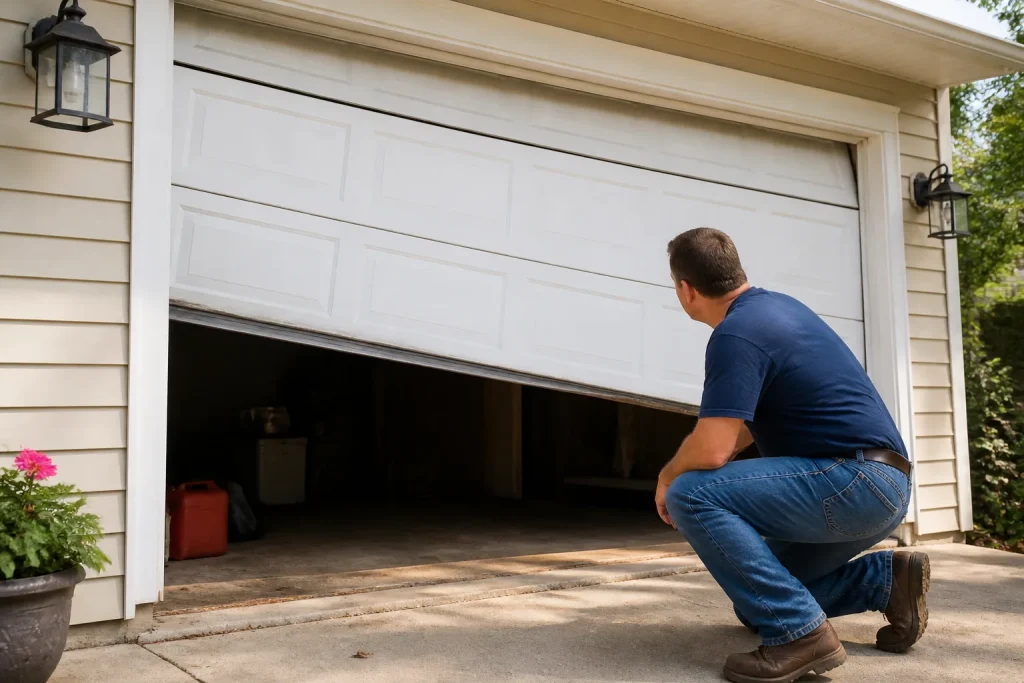
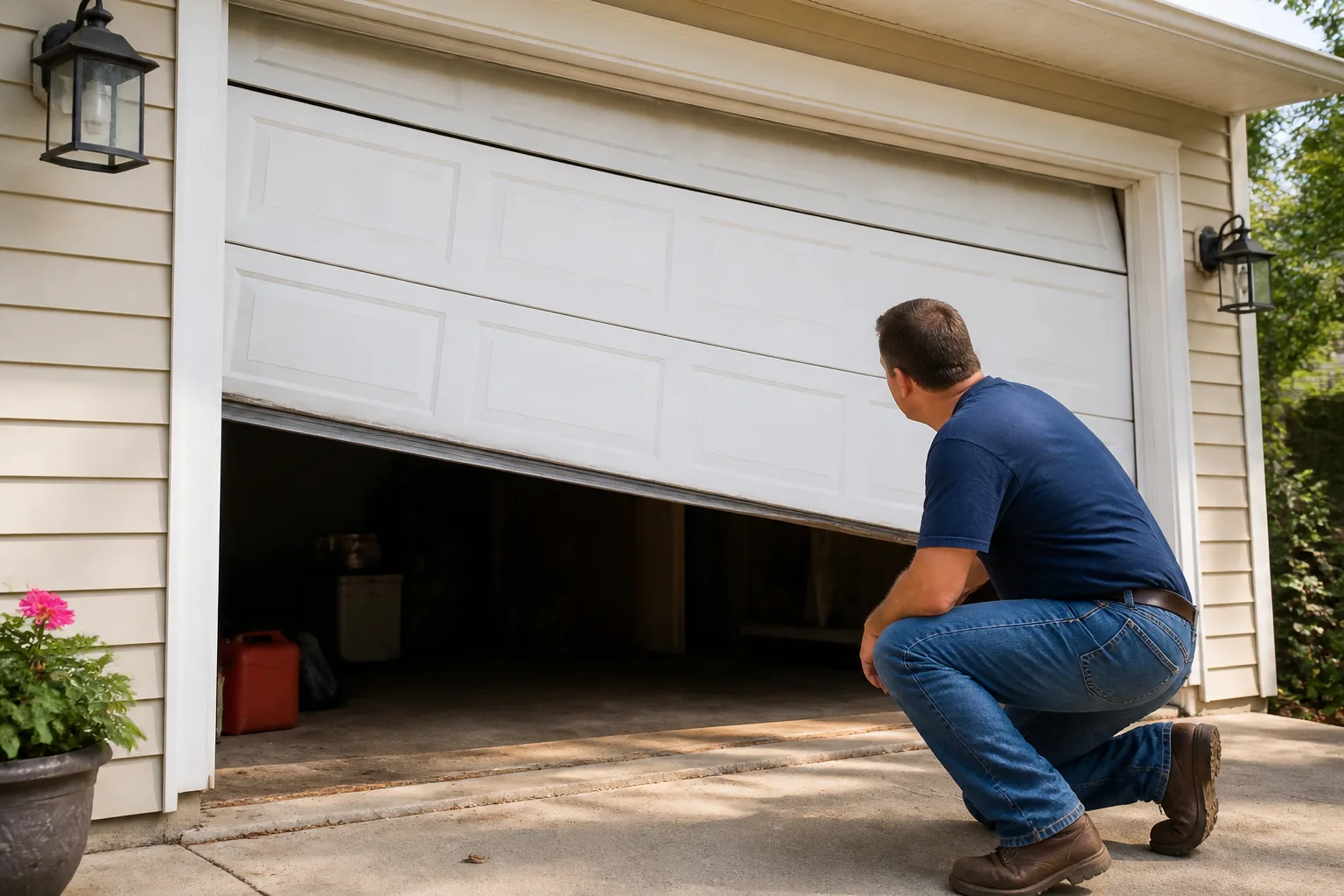
An uneven garage door – one side higher than the other – is almost always a cable or spring problem, not a track problem. Homeowners tend to blame the track because that’s the visible part, but a bent track usually means something else already pulled the door out of alignment. When one cable has lost tension or one spring has weakened, the door lifts at different rates on each side, and gravity finishes the job.
Why the distinction matters: a slightly out-of-square track can wait a short while for a scheduled visit. A slack or fraying cable is carrying live tension, and if it lets go the door can drop on one side – hard. That’s a safety issue, not a convenience issue. It’s also why we check cables and springs before we touch the tracks.
What to look for in Battle Creek homes that see a lot of temperature swing:
- The bottom of the door is visibly crooked when fully closed.
- A gap along one side or corner that wasn’t there before.
- The door shudders or jerks as it rises, then levels out.
- A cable that looks kinked, frayed, or has come out of its drum.
If you spot any of these, keep the door closed and get it inspected. An uneven door is one of the clearest signs you need garage door repair, and catching it before the cable fails saves you the headache of an emergency call.
What Does ‘Slow to Respond’ on a Smart Opener Actually Mean?
A sluggish smart opener has two possible root causes, and they’re completely different fixes. One is connectivity: the app, the Wi-Fi module, or the pairing between your phone and the opener (a common issue on connected LiftMaster and Chamberlain units). The other is mechanical: a weak spring making the motor work harder, worn gears, or a failing logic board. Knowing which one you’ve got tells you whether you’re resetting an app or calling us.
The quick test: press the wall button (the one wired to the opener, not the app). If the door responds immediately from the wall but lags from your phone, it’s connectivity. If it’s slow or straining from both, that’s mechanical, and the opener is struggling against something – usually the door itself.
A few things we see often with connected openers:
- Firmware that’s behind and needs an update.
- A Wi-Fi module that’s dropped off the network after a power blip.
- A door that’s gone stiff over the winter, so the motor strains and can’t hit its programmed travel points.
Opener issues are their own category of garage door opener repair, and because we work with the major brands – LiftMaster, Chamberlain, Genie among them – we diagnose your existing hardware rather than pushing you toward whatever we sell. We identify the real cause before recommending a fix, whether that’s a firmware reset or a spring that’s been dragging the motor down.
The Five-Minute Visual Inspection That Catches Most Problems Early
You can spot the majority of common failure precursors in under five minutes with nothing more than your eyes and a flashlight. You don’t need tools and you don’t need to touch the springs or cables. You’re looking for change – anything that looks different from the last time you paid attention, in Battle Creek or anywhere.
Here’s where to look and what you’re looking for:
- The springs above the door. Look for a visible gap in a torsion spring (a two-piece spring that’s separated) or stretched, gappy extension springs. Any gap means it’s broken or failing.
- The cables. Run your eyes down both sides. Fraying, kinks, or a cable off its drum are red flags. Don’t touch them – just note it.
- The rollers. Look for flat spots, cracks, or rollers that have worn through their bearings. Steel rollers squeal; nylon ones crack.
- The tracks. Check for dents, bends, or debris. Tracks should be straight and clear.
- The seals and weatherstripping. Look for cracks, gaps at the bottom, or a seal that’s pulled away from the frame – the first line of defense against cold air and pests.
- The door panels. Look for cracks, dents, or rust, especially along the bottom section where moisture collects.
If you see a broken spring, a frayed cable, or a door that’s come off its track, stop and call a professional. Everything else on that list is a “get it looked at soon” item. A few minutes now beats a door that won’t close on a cold night.
How Do Battle Creek’s Seasons Speed Up Garage Door Wear?
Battle Creek’s temperature swings are hard on garage doors, and springs and seals take the worst of it. Cold contracts metal, and a spring that was tuned in mild weather can stiffen and lose tension when the mercury drops. That added stress is why so many spring failures happen in the cold months – the metal simply can’t flex the way it did in summer. Seals and weatherstripping harden and crack too, letting in drafts and moisture.
Watch for these early-fall symptoms before winter sets in:
- The door feels heavier or slower as the weather turns cold.
- The opener strains or hesitates on the first cold morning.
- A seal that looks cracked, brittle, or is pulling away from the bottom.
- New squeaks or groans that showed up as temperatures dropped.
Getting ahead of this in autumn – checking tension, lubricating moving parts, and replacing a worn seal – is one of the simplest things a Battle Creek homeowner can do. It’s also why we pay attention to the season when we assess a door. If your door is telling you winter’s coming, that’s worth a look before the first hard freeze.
When to Call a Pro
Some issues you can watch. Others you shouldn’t touch. Call a professional right away if you hear a spring pop, see a frayed or off-drum cable, notice the door is uneven, or find the door hanging off its track. These involve stored force that can injure you in an instant, and they’re not worth testing your luck on. For slower symptoms – a noisy roller, a stubborn smart opener, a worn seal – you’ve got a little more room, but don’t let it slide into a failure.
One call covers it. We handle repair, garage door opener repair, spring work, and new installation, so you’re not coordinating three contractors. And because springs are one of the most hazardous residential repairs, we do that work in-house rather than farming it out. Our technicians have up to 9 years of experience working on the brands most homes actually have.
Related services in Battle Creek: garage door spring repair, opener diagnostics, and garage door installation when a repair no longer makes sense.
The Bottom Line
Most garage door failures aren’t sudden – they’re the end of a warning you didn’t recognize. A slow door, an uneven door, a new sound, a stale smart opener, a cracked seal: each one maps to a specific cause, and each is cheaper and safer to address early. Learn the difference between the sounds, do the five-minute visual check, and get ahead of the seasonal wear that Battle Creek’s weather guarantees. If you’re in Battle Creek and need help, Garage Door Repair Battle Creek offers free estimates – call (844) 964-0574. And if you’re not sure what you’re hearing, that’s exactly the kind of call we’re glad to take.
Frequently Asked Questions
The earliest signs are a door that’s slower than it used to be, new noises during operation, and an uneven bottom edge. A strained opener, a squealing roller, or a cracked seal are also early indicators. Catching these before they turn into a broken spring or a dropped door saves money and hassle. Call (844) 964-0574 for a free estimate.
A broken torsion spring usually shows a visible gap where the spring has separated, and the door may feel extremely heavy or won’t stay up. A weak spring shows no gap but lets the door move slowly or unevenly. Either way, don’t operate it – call a trained technician. Call (844) 964-0574 to get it checked.
No. A slow door is often a weakening spring or a stiff door forcing the motor to work harder – the motor is the symptom, not the cause. Test the wall button versus the app to narrow it down. If the wall button is also slow, it’s mechanical. Call (844) 964-0574 for a diagnosis.
Very likely. We work with 8 of the industry’s most widely installed brands, including LiftMaster, Chamberlain, Genie, Clopay, Amarr, Wayne Dalton, Craftsman, and Raynor, so you won’t be told “we only service what we sell.” Call (844) 964-0574 and tell us what you’ve got.
Written by the team at Garage Door Repair Battle Creek.
Need Garage Door Help?
Call Garage Door Repair Battle Creek - the local pro we connect you with is licensed and insured, here with fast after-hours help in Battle Creek.
(844) 964-0574